How We Helped a Homeowner Fix Their Leaking Windows — Fast

You invite a window company into your home, show them ten fairly ordinary windows, and wait for the estimate. The salesperson taps a few numbers into a tablet, pauses for dramatic effect, and reveals the total: $18,000.
For a moment, you wonder whether the quote includes the windows, the installation, and a small vacation somewhere that is not 115 degrees.
That kind of sticker shock is fairly common in Phoenix. Some companies charge $1,500, $2,000, or even more per window, while another contractor may quote considerably less for what appears to be the same project. Naturally, homeowners want to know what accounts for the difference—and whether the more expensive window is actually better.
Sometimes, the higher price is justified. A large custom window, specialty glass, premium frame material, difficult installation, or damaged opening can add real cost. However, the price may also include commissioned salespeople, expensive advertising, promotional financing, corporate overhead, and a discount structure that begins with an inflated number.
The price alone does not tell you whether a quote is fair. You need to know what product you are receiving, what the installation includes, and where the rest of your money is going. Let’s look at how a fairly ordinary replacement window can wind up costing $1,500 or more—and how to decide whether it is worth it.
Is $1,500 Per Window Too Expensive?
A price of $1,500 per installed window is not automatically unreasonable, but it is high for many standard vinyl replacement projects in the Phoenix area.
That distinction matters because “one window” is not a standard unit of measurement. A small bedroom slider and a twelve-foot opening with multiple panels both count as one window, even though they require very different amounts of glass, material, labor, and possibly some respectful lower-back complaining.
A $1,500 price may be reasonable for an oversized window, premium frame material, custom color, specialty glass, or complicated full-frame installation. Tempered glass, structural repairs, second-story access, and stucco work can also raise the cost. In those situations, the additional money is paying for something tangible.
The number deserves more scrutiny when the quote covers a standard vinyl window with double-pane Low-E glass and a routine installation. If every opening receives the same $1,500 price regardless of size or complexity, ask the company to explain how it arrived at that figure.

A reputable contractor should identify the window, glass package, installation work, and anything that could create additional charges. If the explanation consists mainly of trademarked product names, vague promises, and a discount that disappears when the salesperson reaches your driveway, get another quote.
The goal is not to find the lowest number at any cost. It is to make sure the price reflects the window and installation rather than the performance surrounding the sales presentation.
What Are You Actually Paying for in a Window Quote?
An installed replacement-window price should account for the window, glass package, hardware, screens, removal, installation materials, labor, cleanup, disposal, taxes, and warranty coverage.
That is why comparing an installed quote with a window sitting on a home-improvement store shelf can be misleading. The retail price does not tell you whether the window fits your opening, performs well in Arizona, or will be installed correctly. It also does not include someone removing the old unit without turning the surrounding stucco into a side project.
Professional installation has real value. An installer must measure accurately, order the correct unit, prepare the opening, set the replacement square and level, seal it against air and water intrusion, and make sure it operates properly. Hidden damage or necessary repairs can make that work more involved.
The quote also supports the company performing the job. Contractors have legitimate expenses, including licensing, insurance, vehicles, equipment, administration, warranty service, and experienced crews. They also need to earn a profit if they plan to answer the phone when you have a warranty question several years from now.
The important issue is transparency. A higher price is easier to understand when the quote identifies the product, glass, labor, repairs, and warranty you are buying. When all you receive is a total and a promise that the window is “premium,” you are comparing prices with one eye closed.
When a $1,500 Window May Be Completely Reasonable
Some window projects require more material, specialized manufacturing, additional labor, or repairs that have little in common with a routine replacement. Before deciding that a quote is too high, look at what makes the opening different.
The Window Is Larger Than Standard
Larger units require more glass, stronger frames, and additional labor to transport and install. A wide picture window or multi-panel configuration may also require several installers to move it safely.
This is why flat per-window comparisons can be deceptive. Replacing three large living-room windows is not equivalent to replacing three small bathroom windows, even though both projects contain three openings.
The Frame Material Is More Expensive
Vinyl offers a practical balance of cost, durability, and energy performance. Fiberglass, composite, wood, and wood-clad frames can cost considerably more.
Those materials may be appropriate when a homeowner wants a particular architectural appearance, narrow frame profiles, custom finishes, or features that standard vinyl does not provide. The higher price should correspond to a clearly identified material and benefit—not simply a brochure calling the frame “exclusive.”
The Project Requires Specialty Glass
Standard double-pane Low-E glass is suitable for many Phoenix homes, but certain locations require or benefit from specialty glass.

Tempered safety glass may be necessary near doors, tubs, showers, or stairs. Laminated glass can provide additional security or noise reduction. Obscure glass offers privacy, while decorative patterns and upgraded solar-control packages can also raise the price.
The glass should solve a specific problem. Phoenix already gives us enough heat for free, so paying more for stronger solar control can make sense on certain exposures. Paying for an upgrade nobody can explain is another matter.
The Installation Is Complicated
A straightforward replacement can become a larger job when the opening has water damage, deteriorated framing, unusual construction, or previous installation problems. Full-frame replacement, structural modifications, stucco repair, drywall work, painting, and trim can all increase the cost.
Access matters too. A second-story window above a patio cover is more difficult to reach than a ground-floor window beside the driveway. Windows above stairs, tubs, landscaping, or other obstructions may require additional equipment and time.
The Window Is Custom or Unusual
Bay and bow windows, casements, custom shapes, oversized architectural units, and specialty colors are rarely priced like standard sliders or single-hung windows.

In these situations, $1,500 may represent fair value. The contractor should still explain what makes the window more expensive. A legitimate additional cost usually has a specific product feature, installation condition, or repair attached to it—not merely an enthusiastic salesperson.
Why Standard Windows Sometimes Reach $1,500 or More
Specialty products and difficult installations explain some expensive windows. They do not explain every expensive quote.
A standard vinyl replacement window can reach $1,500 or more because the homeowner is paying for the company’s sales and operating model. Every contractor has overhead and needs to earn a reasonable profit. Some companies simply operate much more expensively than others.
Sales Commissions
Many large window companies send commissioned representatives to the home. The salesperson may spend hours demonstrating products, discussing financing, and working through several versions of the price.
That representative must be paid, and the commission is ultimately funded by the customer. This does not make the company dishonest or the window bad, but it can add an expense unrelated to manufacturing or installation.
It is reasonable to ask whether the estimator earns a commission and whether the price changes based on how the sale is negotiated.
Advertising and Lead-Generation Costs
Television commercials, radio spots, direct mail, online advertising, sponsorships, and purchased leads are expensive. In a competitive market such as Phoenix, a company may spend substantially just to schedule one appointment.
Advertising is a normal business expense, but it is built into the final price. If you see the same company during every commercial break, there is a decent chance its customers are helping pay for all that quality time together.
Showrooms and Corporate Overhead
Large organizations may operate showrooms, call centers, warehouses, vehicle fleets, administrative departments, and regional management teams. Franchises may also carry fees associated with using a national name.
That infrastructure can provide value through convenient service, established systems, and broad warranty support. It can also increase the amount the company must earn from each project. Company size and operating structure affect the quote even when the physical window does not change.
Promotional Financing
Financing can make a major project easier to manage, but it is not necessarily free because an advertisement says “no interest” or focuses on a low monthly payment.
The contractor may pay fees to the financing provider, and those costs can be reflected in the price. Deferred-interest offers may also carry strict conditions.
Ask for the cash price and the total financed cost. A window does not become less expensive because its price has been divided into 120 friendlier-looking pieces.
Discount-Based Pricing
Some companies begin with a high list price and reduce it through seasonal, neighborhood, manager-approved, or same-day discounts.
The final number may still be competitive, but the size of the discount does not prove that the quote is a good value. A window marked down from $2,300 to $1,500 still costs $1,500.
Focus on the final installed price, exact product, and complete scope of work. If the company will not give you time to compare the quote without withdrawing the offer, the urgency may be part of the sales process rather than a genuine change in cost.
Does a Higher Price Mean a Better Window?
A higher price can indicate better materials, advanced glass, stronger warranty coverage, or complicated installation. It can also indicate higher commissions, advertising expenses, financing costs, and overhead. The price alone does not tell you which explanation applies.
Instead of relying on labels such as “premium,” “elite,” or “exclusive,” request information you can compare. The National Fenestration Rating Council, or NFRC, rates complete window systems using standardized measurements.
For a Phoenix home, pay particular attention to the solar heat gain coefficient, or SHGC. This measures how much solar heat enters through the complete window. Lower numbers generally indicate greater resistance to solar heat gain, which is especially relevant for windows receiving intense southern or western sun.
The U-factor measures how readily heat passes through the window. Visible transmittance measures how much daylight passes through the glass. These ratings should be considered together because stronger solar control can also affect a room’s brightness and the appearance of the glass.
Compare the frame, hardware, spacer system, weatherstripping, warranty, and installation method as well. A strong window can perform poorly when installed incorrectly, while good installation cannot transform the wrong product into the right choice for an Arizona home.
Expensive windows can be excellent. Moderately priced windows can be excellent too. The better value is the product that delivers the performance your home needs, is installed correctly, and comes with dependable support afterward.

A Note from Travis
I have no problem with an expensive window when the project actually calls for one. Some openings are huge, some installations are difficult, and some homeowners want premium materials, custom colors, or specialty glass. Those things cost more, and a good contractor should explain why.
What bothers me is when a standard replacement window gets an extraordinary price without a clear explanation. If you are being asked to pay $1,500 or more per window, the company should show you exactly what makes the product, installation, or warranty worth the difference.
How to Tell Whether a Window Quote Is Fair
A fair quote does not have to be the lowest. It should explain what you are buying, what work will be performed, and what happens if something goes wrong afterward.
Before comparing totals:
- Identify the manufacturer and product line. “Premium vinyl window” is a description, not a model number.
- Compare equivalent styles and sizes. Separate oversized and specialty units from standard openings.
- Request the NFRC ratings. Do not assume two windows are equivalent because both contain double-pane Low-E glass.
- Confirm the installation method. Ask whether the quote covers standard replacement, full-frame installation, or another approach.
- Check what is included. Confirm removal, disposal, screens, hardware, installation materials, cleanup, taxes, and permits.
- Discuss surrounding repairs. Stucco, drywall, paint, trim, and damaged framing may be included, excluded, or priced separately.
- Compare cash and financing prices. Evaluate the total financed cost, not just the monthly payment.
- Review both warranties. The manufacturer’s product warranty and contractor’s installation warranty provide different coverage.
- Verify licensing and insurance. A low estimate loses its charm when the installer disappears or a warranty claim becomes nobody’s responsibility.
- Get two or three detailed quotes. Two comparable estimates are more useful than five vague totals covering different products and scopes.
Once you have this information, the price begins to make sense—or it becomes obvious that it does not. A contractor who believes in the value of the job should explain the quote without relying on pressure, confusion, or a calculator that only works at your kitchen table.
How Factory Direct Windows Keeps Its Average Price Lower
At Factory Direct Windows, our current average is approximately $750 per window installed when replacing all the windows in a home. That includes Low-E glass, professional installation, and tax.
We keep that average lower by working directly with manufacturers, controlling our overhead, and not building commissioned salespeople or layers of middlemen into the price. Much of our work comes through referrals, which also helps us avoid passing a massive advertising budget along to every homeowner.
That does not mean every window costs exactly $750. Larger openings, specialty glass, custom configurations, unusual colors, difficult access, and repair work can affect the final price. A realistic quote still requires accurate measurements and a clear understanding of the project.
It also does not mean every company charging more is doing something wrong. Another contractor may offer a different material, product, installation method, or service package. Our approach is to explain what you are getting, tell you what it costs, and avoid turning the estimate into a negotiation tournament.
The goal is not to be the cheapest under every imaginable circumstance. It is to make sure Phoenix homeowners are paying for the window, installation, and dependable service—not layers that do not improve any of them.
Get a Straight Answer About Your Window Project
A $1,500 window is not automatically overpriced, just as a lower-priced window is not automatically a bargain. The question is whether the cost reflects better materials, specialty features, complicated installation, or something else.
Before signing a contract, ask for the exact product, glass package, NFRC ratings, installation method, warranty coverage, and a written explanation of what the price includes. If the company can justify the quote, you can decide whether those features are worth paying for. If the explanation relies mostly on pressure, promotional math, and a discount that expires before dinner, keep shopping.
Factory Direct Windows currently averages approximately $750 per window installed when replacing all the windows in a home, including Low-E glass, professional installation, and tax. Your actual price may vary based on the size, style, glass, and condition of each opening, but we will explain those differences before asking you to decide.
To get a free, no-obligation quote, call Factory Direct Windows at (602) 703-0131 or visit factorydirectwindows.com. We serve homeowners throughout Phoenix, Mesa, Chandler, Gilbert, Tempe, Ahwatukee, Scottsdale, Glendale, Peoria, and surrounding communities.
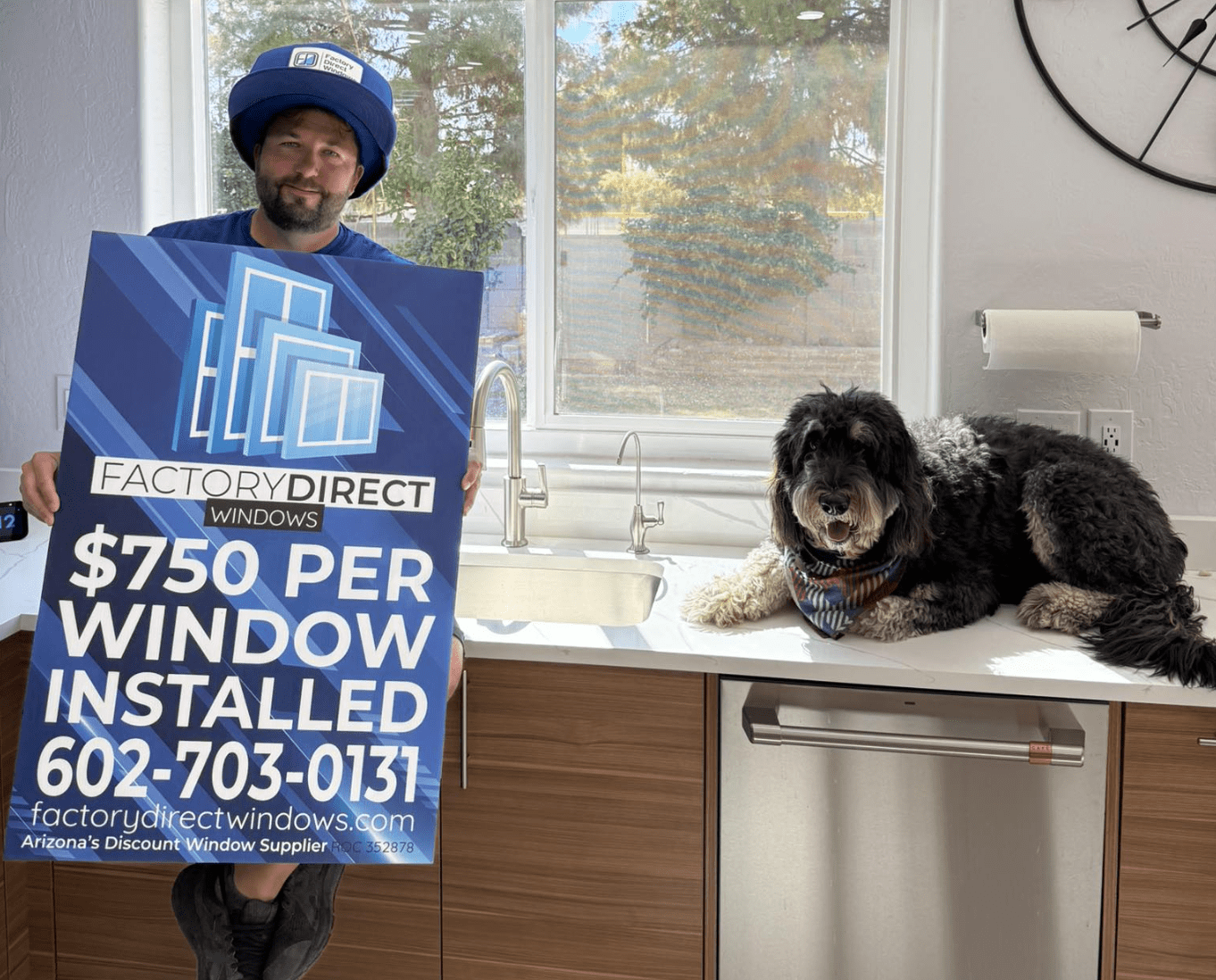
Travis Hyre
A native Phoenician who now lives in Gilbert, Travis specializes in straightforward advice, retrofit window installations, and giving homeowners his personal cell number instead of sending them through a maze of commissioned salespeople. But everyone knows the real boss is Simba, his giant poodle, whose responsibilities reportedly include supervision, morale, and making sure Travis does not get too comfortable.